How to Present UX Research Findings to Get Buy-In From Stakeholders
Finding UX issues on your website is one thing, but justifying the investment in getting them fixed is another. See how to do it with firsthand insights from Baymard’s experienced UX team.

Key takeaways
- Lead with evidence to eliminate subjective opinion and overcome HiPPO influence
- Translate design friction into commercial outcomes like revenue impact, risk reduction, or lower support costs
- Frame presentations around concrete business decisions and leverage loss aversion to prompt action
33.8%
of UX practitioners report the highest level of resistance from stakeholders
Finding UX issues on your website is one thing. Securing the backing to get them fixed is a whole other ballgame.
When your findings fail to get stakeholder buy-in, the cost of doing nothing adds up fast. Recommendations sit untouched in the backlog, dev teams waste hours building features users struggle to navigate, and silent usability friction keeps harming your conversion rates.
In a Nielsen Norman Group survey of 126 UX practitioners, lack of stakeholder buy-in came up as one of the most common challenges. In another industry survey, more than half of respondents said they frequently deal with resistance from leaders, with 33.8% reporting the highest level of resistance on a seven-point scale.
Over time, a lack of buy-in erodes trust in the entire UX process, leading to tighter budgets, smaller teams, and getting pushed into taking orders instead of shaping strategy.
But unless you can effectively communicate your findings, validate them, and present the roadmap to resolve the problems, the conversation stalls and goes nowhere. And that means those user friction points remain.
At Baymard, many of our team members are well-versed in presenting UX challenges to the C-suite or leadership teams. In this guide, we share some of their advice on how you can win over the boardroom and get stakeholders onside.
Why UX findings fail to get stakeholder buy-in
To nail a presentation, you first need to know what doesn’t work. Here are some reasons why UX presentations don’t get the buy-in they need.
Findings feel like opinions
Without external benchmarking or research grounding, stakeholders have no basis to agree or disagree with your findings. That can mean they feel no pressure to act. In some cases, you might find your recommendations overruled by “HiPPOs” (the highest paid person’s opinion).
According to Laura Messina, Senior UX Audit Coordinator at Baymard, achieving buy-in relies on proving that recommendations aren't just subjective preferences.
“When recommendations are backed by objective research rather than internal opinion, you're not just catering to the loudest voice or the HiPPO — you're bringing independent intelligence that decision-makers can actually act on.”

Recommendations are communicated as creative ideas
Ania Klimczuk, Applied AI Engineer with several years of UX auditing experience at Baymard, says that UX findings often fail when communicated as purely creative ideas or design preferences.
Securing buy-in requires translating findings into the outcomes a stakeholder prioritizes, such as risk reduction for legal teams or cost efficiency for finance leaders, explains Ania.
“My biggest takeaway from working with different stakeholders — from business to finance to legal — is framing whatever your UX findings are in the lens of what that specific stakeholder cares about.”

Findings are over-critical
There’s an element of balance required when presenting usability issues. Rebecca Hugo-Terrey, Audit Lead at Baymard, says “no one wants to find out their baby is ugly.” She suggests using neutral, third-party framing to prevent stakeholders from becoming defensive about their product.
“The presentation is often delivering critical feedback, so it's better to frame it through neutral data: ‘The research indicates this user behavior’, rather than attacking their design.”

Ania’s experience backs this up:
“When you're working in a legacy company, you have executives who have been there for 15 or 20 years. To convince them to make a dramatic change when something has worked for a long time, you really do need to frame it in a perspective they understand.”
The findings aren’t connected to business outcomes
UX leaders present usability issues, but stakeholders respond to revenue impact, conversion rates, and risk aversion. The link between the two is often missing in presentations, and without it, even well-evidenced findings may be dismissed as nice-to-haves.
Laura explains:
"Tactical fixes are fantastic for the people doing the work, but if we're talking about people leading an arm of a business, it's not about the minutiae. It's about the strategic overlay on top of that."
Build your findings on external evidence, not internal opinion
One of the clearest paths to getting your voice heard is to lead with evidence, rather than opinion. Supplement findings with established industry UX research to add credibility to your presentation and avoid the internal politics.
Baymard’s platform helps UX leaders to back their findings with evidence-based data, something Rebecca says can help in getting stakeholders onside. “Suddenly, you carry this weighty authority. You're bringing facts rather than internal opinion”, she says.
Ania agrees that having evidence-backed recommendations makes it easier to win over executives:
“If you have a stubborn stakeholder, you can run an A/B test on site to prove something, or you can use external data to demonstrate that across hundreds of sites, users struggle with this exact same issue.”
Meanwhile, Rebecca says that “personal pronouns don't exist”. Instead, your commentary should focus on the facts: “it's not ‘we think’, it's ‘the data indicates’”, she says.
Justify your UX designs & get stakeholder buy-in
Build bulletproof designs with insights that are specific to your UX focus. Find guidelines for every UI component, giving you actionable direction that is proven to convert.
Translate findings into business language before the meeting
UX leads must articulate issues using commercial metrics. “The big question isn't ‘what is happening?’ — it's ‘why should we care about it?’ Everything needs to be put into perspective”, says Rebecca.
This might involve tying recommendations to conversion rates, return on investment (ROI), or customer lifetime value (CLV), but can also extend to other business measures like customer satisfaction (CSAT), Net Promoter Score (NPS), call-center volume reductions, or reduced legal risk.
In Ania’s experience, linking usability issues and recommendations to the outcomes business leaders care about is crucial:
“UX is great and wonderful, but how is it impacting customer satisfaction scores or translating to cost reduction? Can it decrease live support calls or chats? If you can quantify these things in business metrics, stakeholders sign off because you're speaking their language.”
Ania has firsthand evidence that framing an outdated layout as a "legal liability" or a support burden immediately captures executive attention. In a previous role with a large American telco company, Ania’s team identified a user friction point caused by a legal disclaimer.
She explains: “We pitched a layout redesign to the legal team by showing that the current structure was actually a legal liability and risk. Showing clearer terms reduced customer complaints and support calls — making it a win for legal, customer service, and UX.”
One of Ania’s key pieces of advice is to use real friction points as a way to illustrate your point.
“Personal anecdotes are really great for the educational piece — tell them a story that they can relate to of a frustration with a website, because all of us have had a frustration with a website. Using user quotes from surveys is also a really useful tool. If you have a customer who is saying, ‘What did you do to the account section? I can't find anything. Why did you do this?’, it helps humanize what that UX issue is and it helps make it more real."
See how much revenue you’re leaving on the table
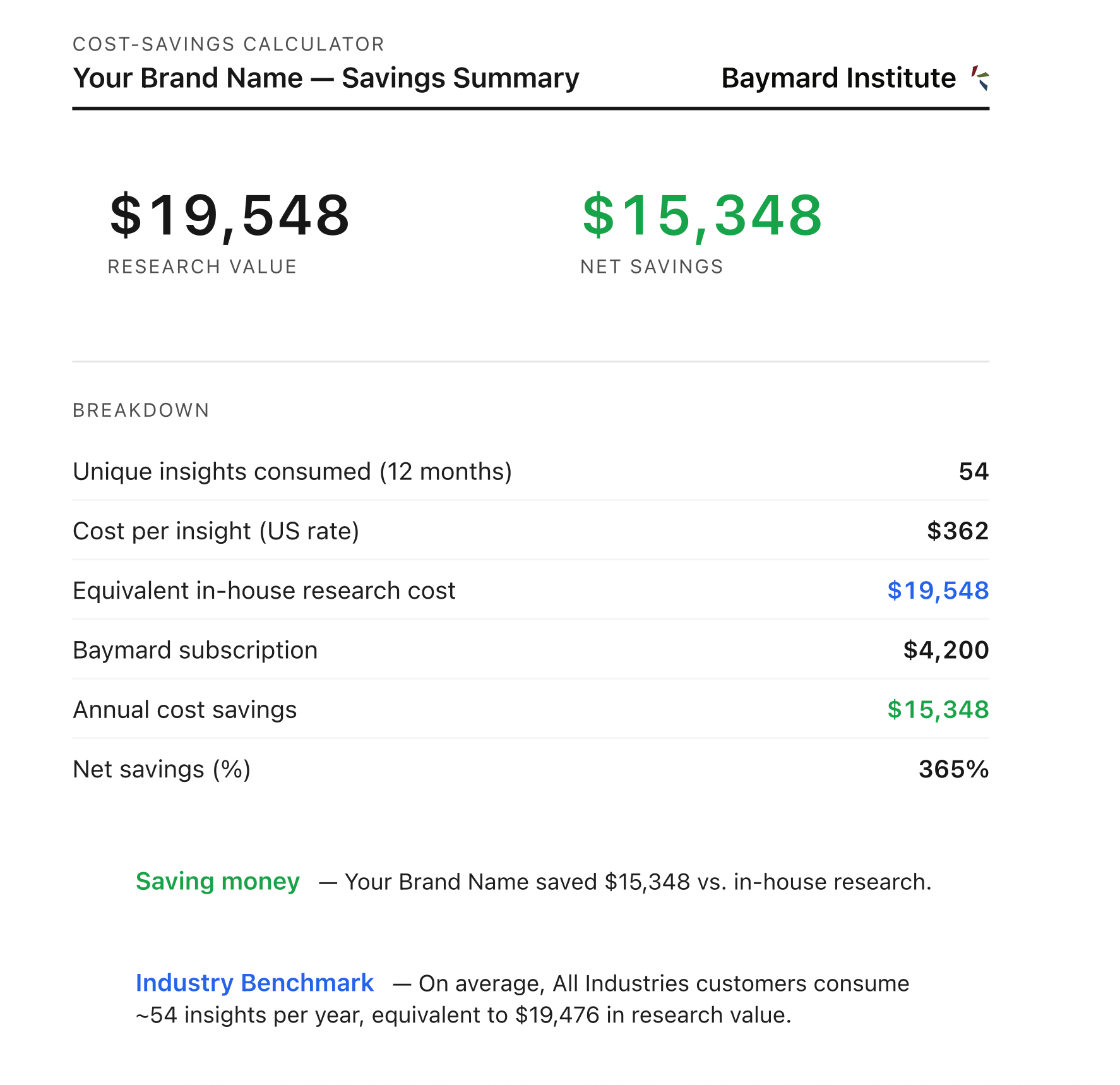
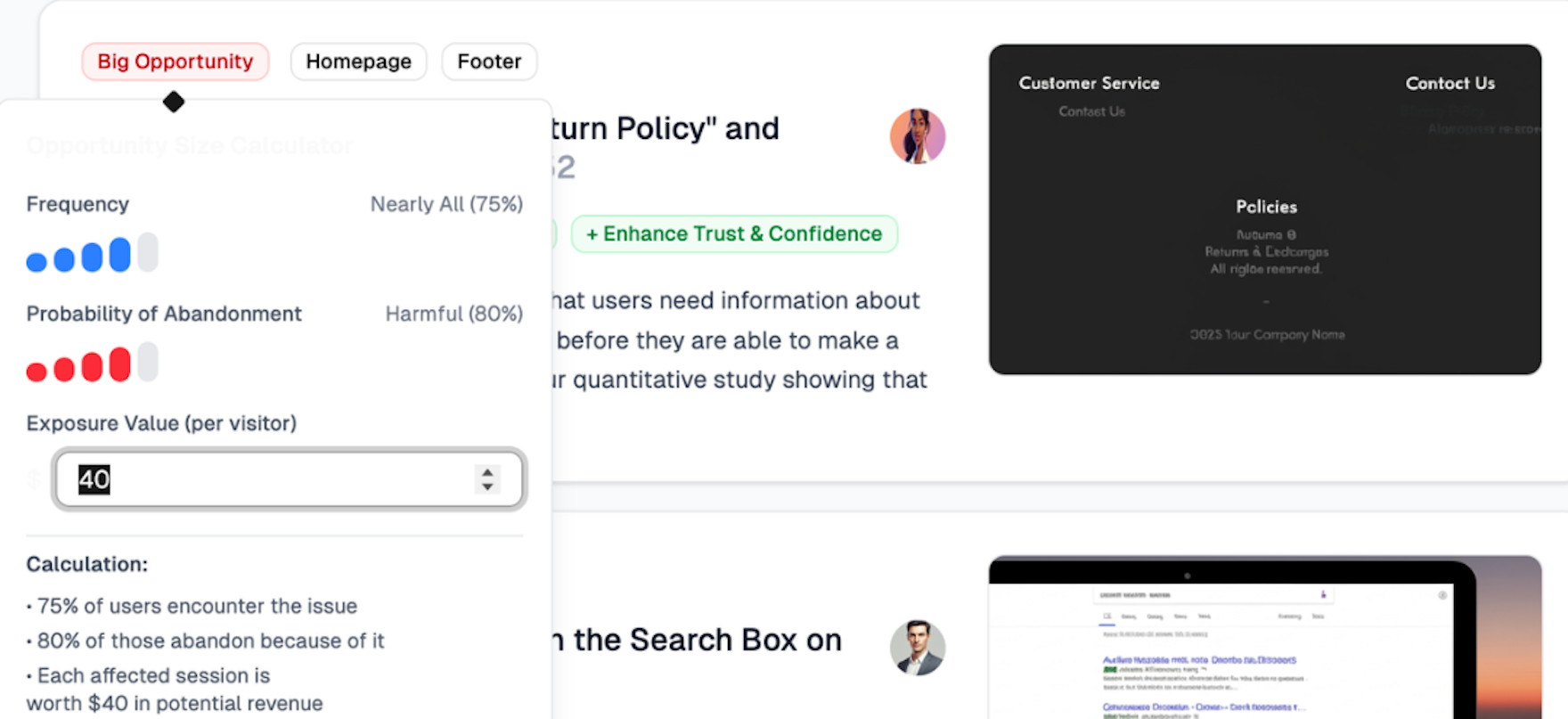
Stop guessing which design fixes get funded. Baymard’s Opportunity Sizing Calculator ties specific usability insights directly to top-line revenue, giving you the bulletproof ROI data needed to win executive buy-in every time.
Structure the presentation around decisions, not discoveries
One of the core purposes of presenting to stakeholders is sharing the UX issues your research uncovered. But to get buy-in, you need to frame the issue along with the suggested fix. You have to demonstrate how your recommendations will impact the company positively.
If you’re presenting slides, don’t just include an issue; highlight the problem, but provide a business consequence, and a fix.
“When you frame UX decisions in the context of business decisions and how they impact the business, it's easier to push things through rather than ‘this is just a fun idea from the creative team’”, says Ania.
She continues:
“It can also be framed in terms of the impact if we don't make a decision. So if we don't make this decision, if we don't prioritize this on the roadmap, then these are the consequences.”
This is backed up by Anja Feibel Meerwald, Market Research Associate at Baymard. She researched framing results to stakeholders as part of her thesis, and found that leading with a negative lens can be more effective in securing buy-in.
“I researched how stakeholders react to positive versus negative framing, like ‘80% of users had no issues’ versus ‘20% of users struggled’. I found that stakeholders were much more likely to act on suggested changes when the data was presented with a negative frame. It aligns directly with game theory and loss aversion: the pain of a potential loss is psychologically more powerful than the pleasure of a gain.”

As Rebecca suggests, delivery is key:
“Changing tone, attitude, and positioning will change how your message is received. The concept and findings might be the same, but tailoring the delivery is what actually secures buy-in.”
You can use established UX benchmarks, best practice examples, and data to help build your case. Laura says:
“Benchmarks are about prioritization — making decisions around what to focus on first. Data helps you prioritize in terms of impact weights and real business return.”
Anticipate stakeholder objections and have confidence in your delivery
We’ve all heard the typical feedback:
- “We don't have data to prove this”
- “Our users are different”
- “There are bigger priorities right now”
Laura says that aligning expectations from the start is hugely important.
“To avoid objections, you have to set the stage in the first two minutes. Make sure stakeholders 100% understand the methodology and how you arrived at these findings before you jump into recommendations.”
However, there’s always going to be some element of pushback. You need to be as prepared as possible to overcome those challenges.
Bringing the receipts of your research (the data that backs up your observations) is critical. Third-party benchmarks and established UX patterns can also help to drive the conversation forward.
“When stakeholders say ‘but we're different’, third-party research supports that the internet is the internet — people expect standard web patterns, and we shouldn't put roadblocks in front of them. ”
And you need to be able to speak with confidence, avoiding ambiguity. Rebecca states that “hedging is one of the big things that derails otherwise incredibly competent UX leads.”
After the presentation — keeping findings visible
When your presentation comes to a close, make sure you provide stakeholders with clear next steps and summarized recommendations. Include essential information like priority, business consequence, effort required, and a timeline.
Also, reiterate any permissions you need before signing off. Rebecca says that “stakeholder purpose changes how you pitch. There is a fundamental difference between asking a stakeholder for money, asking for resources, or asking for permission. You have to know what decision you're driving toward.”
It’s important that there’s follow-up work that comes from the recommendations, which means ensuring UX remains a visible and respected part of the organizational culture at the leadership level.
“A lot of organizations get set in a ‘moment in time’ mindset rather than adopting a continuous measurement culture. UX isn't something you fix once and walk away from; it needs to be built into your systems.”
Ania recommends keeping leaders updated with progress to help build that visibility and build wider recognition of the UX team’s output and how the team works cross-functionally.
She also says that this can help to build stronger relationships by spotlighting the power of UX:
“Part of it is relationship building and part of it is evangelization — evangelizing for why this discipline is needed. When you bring those stakeholders along for the journey and get their inputs, they feel like they have ownership in some of these bigger projects.”
Justify your UX decisions with research-backed data and best practices
Getting stakeholder buy-in is not about giving a flashier presentation. It’s about connecting design issues directly to business risks.
When you translate user friction into metrics like revenue impact or support costs, ground your points in established research, and frame choices around clear business decisions, UX stops looking like a nice-to-have and starts driving strategic decisions. Leading with independent data moves the conversation past personal opinions so you can focus on making progress.
For your next stakeholder meeting, make sure you check these boxes:
- Before the meeting: Translate friction into commercial risk/ROI metrics and ground recommendations in independent research
- During the meeting: Lead with evidence over opinion, frame issues around clear decisions, and leverage loss aversion
- After the meeting: Define immediate next steps (effort, timeline, permissions) and keep leaders updated to build a continuous measurement culture
Fed up of having your design decisions overlooked and overruled? Back them up with 200,000+ hours of large scale usability testing and evidence-backed UX insights, and end the debate.
When findings are grounded in Baymard's 200,000+ hours of usability research, you’re prepared with evidence that is harder to dismiss, easier to translate into business outcomes, and more likely to result in prioritized action.
End the debate with a data-backed UX audit
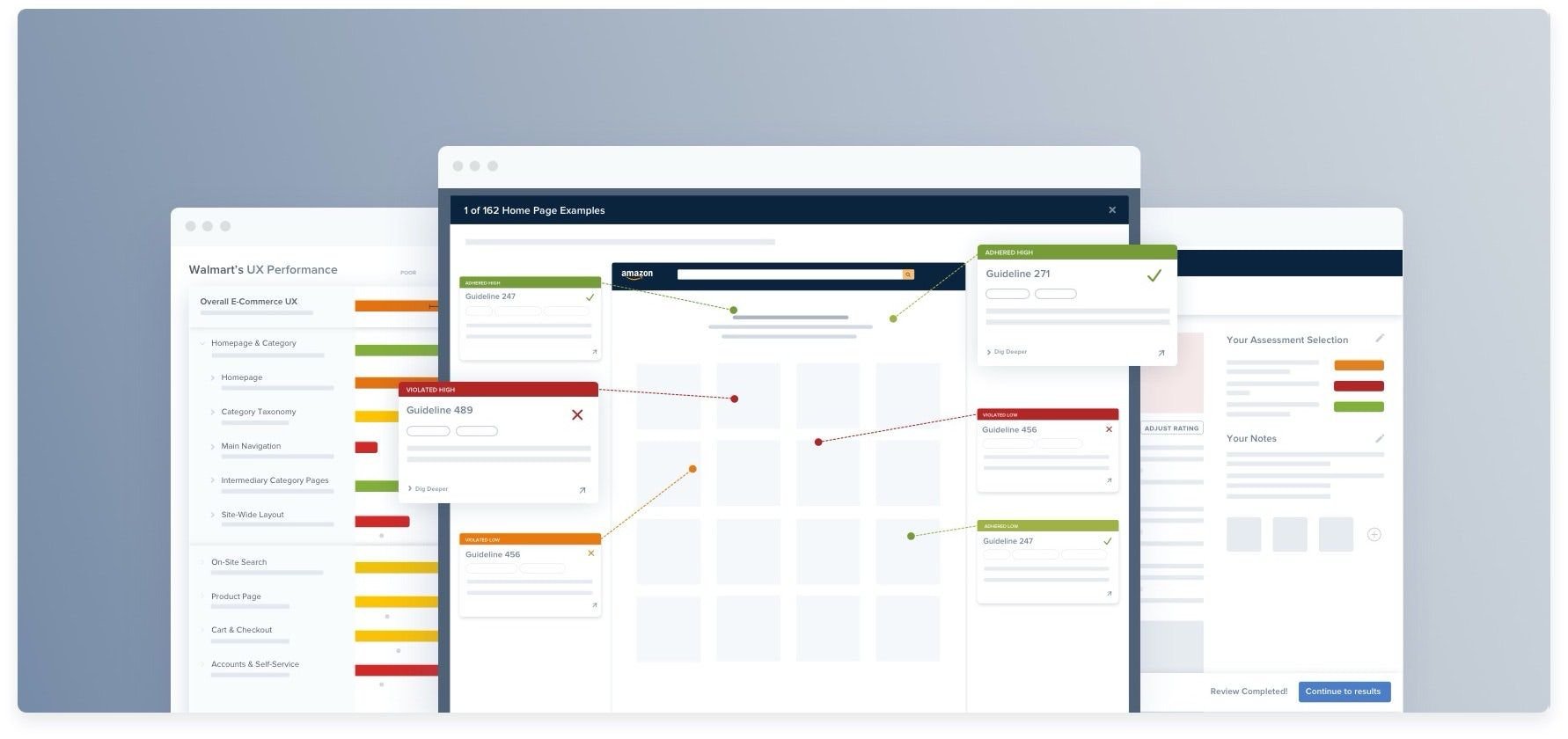
Baymard's human-led UX audit service reviews your key user journeys and flows against 200,000+ hours of research and data-backed UX best practices.
“It is immensely valuable having a thorough, independent study to help validate my work and in particular, help facilitate buy-off from stakeholders. Baymard has quickly become one of my most trusted resources for the UX/UI field.”

Weekly UX Research, Insights, and Updates
Join 60,000+ UX professionals. Get the latest UX research, practical guides, and Baymard news delivered to your inbox every week.
Loading...