At Baymard, we’ve just released a new UX benchmark with 6 new “B2B Electronic Components & Machinery” UX case studies.
This follows from our large-scale user testing on B2B Electronic Components & Machinery UX and adds to our existing ecommerce UX benchmark.
In this article, we give you a snapshot of the overall UX performance.
6 B2B Electronic Components & Machinery UX Case Studies and the Overall Performance
These are the 6 in-depth B2B Electronic Components & Machinery UX case studies.
The 6 sites have been manually assessed across 420+ research-based UX parameters relevant to B2B Electronic Components & Machinery, resulting in 2,600+ weighted UX performance scores and 2,000+ best practice examples from these desktop and mobile sites.
Each of the 2,600+ UX performance scores from the 6 B2B Electronic Components & Machinery case studies is summarized in the interactive scatterplot below — showing you how they perform collectively and individually:
The overall UX performance of the B2B Electronic Components & Machinery sites ranges from “poor” to “decent”, with most sites performing poorly and only one site within the “decent” range.
Here are just a few of the overarching UX issues we observed.
The B2B Electronic Components & Machinery sites largely fell short of the UX standards the procurement context demanded.
Compatible parts, substitutes, and alternatives were almost entirely unsupported across the industry.
In a domain where out-of-stock and end-of-life parts were routine, the inability to reach validated alternatives from the product page left a significant sourcing gap.
B2B ecommerce signals were frequently missing at the point where purchasing decisions needed to be made.
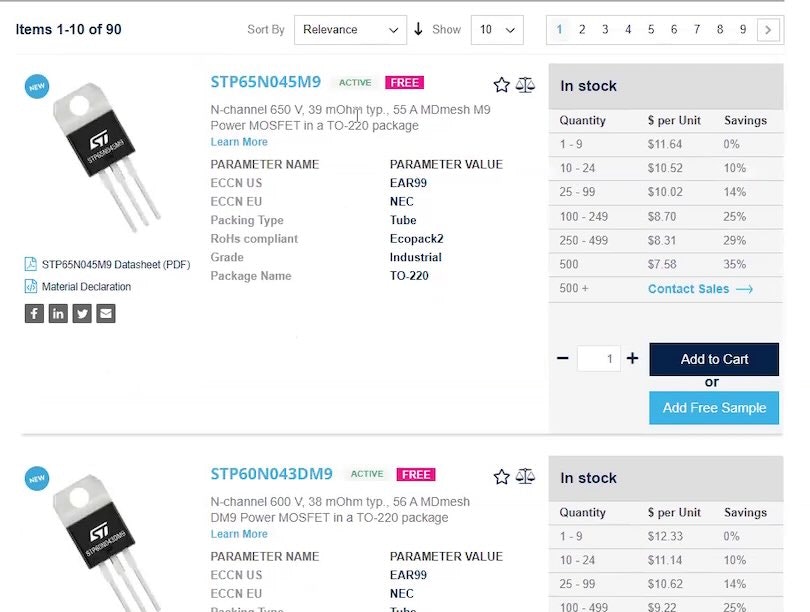
Minimum order quantities and volume price breaks (see guideline #2432), shipping timeframes, and in-stock quantity were inconsistently surfaced across both the Product Table and the buy section.
In a procurement context defined by fixed budgets and project deadlines, their absence left the most critical purchasing inputs unavailable at the point where decisions needed to be made.
Cart information and B2B-specific functionality fell short of procurement expectations
Around a third of sites fail to provide key B2B shipping and delivery details in the cart, omitting information directly relevant to procurement deadlines at the first point where order costs are evaluated.
More than half of the sites provide no “Share,” “Download,” or “Save” features for cart contents.
In a B2B context where orders frequently require internal review or approval before purchase, the absence of these features forces reliance on workarounds such as screenshots or manual transcription.
In summary, across the moments that mattered most in the procurement workflow, evaluation, comparison, and ordering, the sites provided limited support.
As this benchmark shows, with only 1 site delivering a “decent” overall user experience, there is plenty of room for improvement.
A publicly available overview of the research and benchmark can be found on our B2B Electronic Components & Machinery UX research overview page.
Getting access: all 2,600+ UX performance scores, 2,000+ best practice examples, and the UX insights from researching the B2B Electronic Components & Machinery ecommerce industry are available immediately and in full within Baymard. (If you already have access through an account, open the B2B Electronic Components & Machinery UX Benchmark collection.)
If you want to know how your electronic components or machinery desktop and mobile sites perform and compare, then learn more about getting Baymard to conduct a B2B Electronic Components & Machinery UX audit of your site.